
Lagotto Romagnolo Breed Standard
The Lagotto Romagnolo is a small to medium-sized, well-proportioned and powerfully built dog of nearly square proportions. Its hallmark features are its rustic appearance and dense, curly coat of woolly texture.
The breed standard defines far more than appearance. It also safeguards function, temperament and the characteristics that define the Lagotto Romagnolo, from its origins as a water dog to its modern role as a specialist truffle-searching dog.

A Dog of Nearly Square Proportions
The Lagotto Romagnolo should appear compact, balanced and functional. It is powerfully built without being heavy, while retaining the natural, rustic appearance typical of the breed.
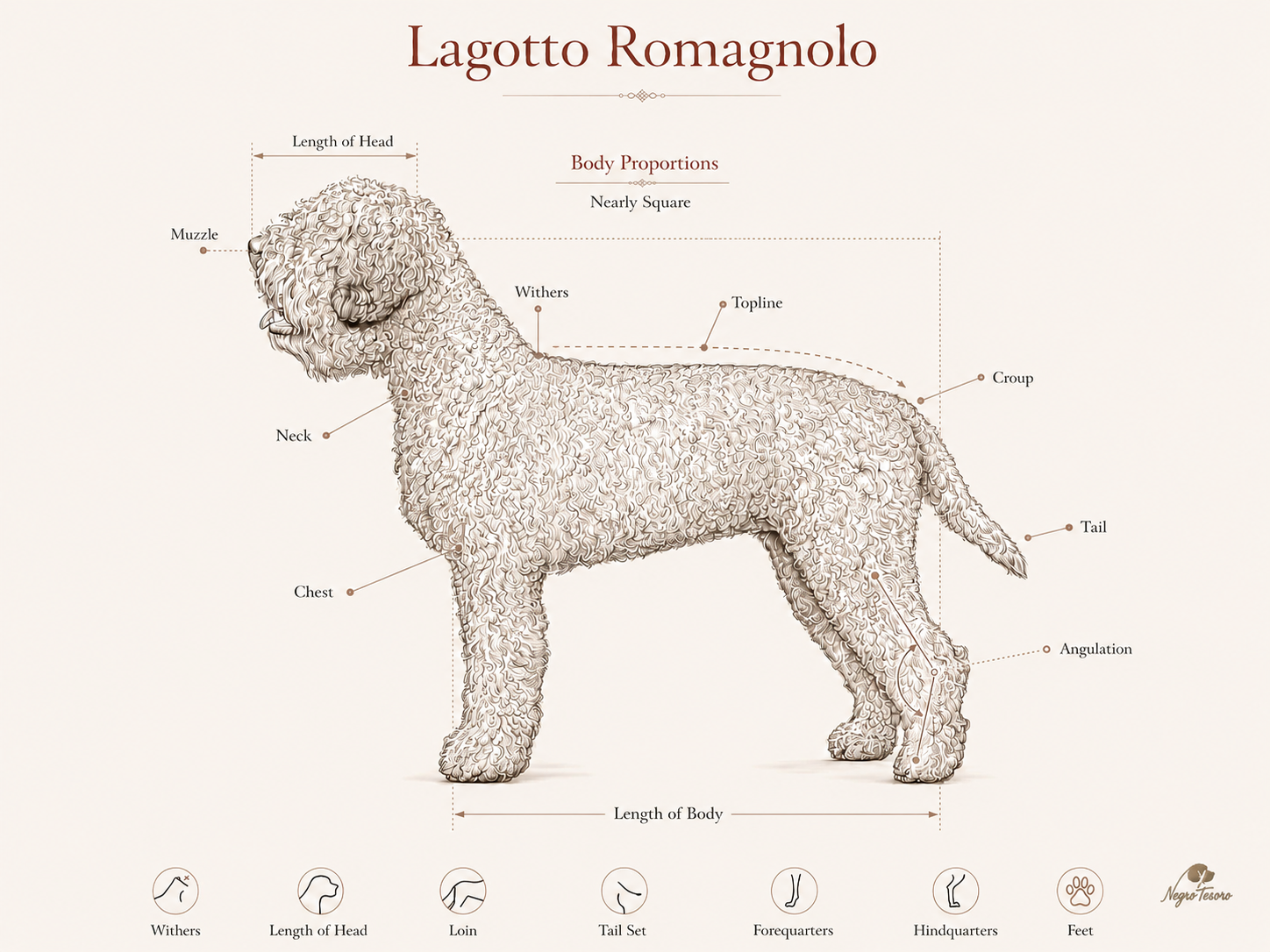
Body length, measured from the point of shoulder to the point of buttock, is approximately equal to the height at the withers, giving the dog a nearly square outline. The head measures about four-tenths of the height at the withers, and the depth of chest is slightly less than half the dog's height.
Correct proportions are not an end in themselves. They support free, purposeful movement and preserve the breed's working character.
Measurements According to the Standard
Body Structure of the Lagotto
A correct representative of the breed should appear harmonious, compact and functional. The diagram illustrates the breed's basic proportions, the position of key anatomical points and the nearly square outline typical of the Lagotto Romagnolo.
A Typical Head, Never Exaggerated
Viewed from above, the head should be slightly trapezoidal and moderately broad. The skull is slightly longer than the muzzle, and the upper longitudinal axes of the skull and muzzle diverge slightly. The muzzle should therefore appear neither short, pointed nor fine.
The Lagotto's expression is alert, intelligent and lively. Large, rounded — but never exaggerated — eyes, triangular drop ears and abundant eyebrows, moustache and beard all contribute to its characteristic expression.
What to Look for in the Head
Broad at the level of the zygomatic arches, slightly convex and tending to flatten towards the rear. The stop is evident but not too pronounced.
A little shorter than the skull, fairly broad and slightly narrowing towards the nose. The nasal bridge is straight.
Large, with wide-open, mobile nostrils. Colour ranges from light to dark brown according to coat colour.
Large but never exaggerated, rounded and set fairly well apart. Iris colour ranges from ochre through hazel to dark brown.
Medium-sized, triangular with rounded tips; hanging at rest or slightly raised when the dog is attentive.
Complete, white and well-developed teeth. Scissor or pincer bite; a slightly reverse scissor bite is acceptable.
Functional Construction
The Lagotto's body is compact and strong. The topline is straight from the withers to the croup, with the withers higher than the croup. The back is straight and muscular, the loin short, strong and slightly convex, and the croup long, broad, muscular and slightly sloping.
The chest reaches the elbows. It is fairly narrow in front and widens towards the rear. The limbs should be straight, strong, correctly positioned and appropriately angulated.
At a walk, movement is regular; at the trot, energetic and brisk. Overall movement should be balanced and purposeful, without heaviness or exaggeration.
Straight and Firm
Straight from the withers to the croup, with the withers higher than the croup.
Straight and Strong
Straight, strong, correctly aligned and appropriately angulated.
Reaching the Elbows
Well developed, reaching the elbows and widening towards the rear.
Energetic and Brisk
Regular at the walk; energetic and brisk at the trot.
Curly Coat, Grooming and Colours
The Lagotto's coat is of woolly texture, semi-rough on the surface, with tight, ring-shaped curls and a visible undercoat. The topcoat and especially the undercoat are waterproof, reflecting the breed's origins as a water dog.
Curls are evenly distributed over the body and tail; on the head they are looser, forming abundant eyebrows, moustache and beard. The coat must never be corded or excessively styled, nor fashioned in the manner of a Poodle or Bichon Frisé.
Woolly, Curly, with Undercoat
The coat has a woolly texture, tight ring-shaped curls and a visible undercoat.
Natural, Never Over-Styled
The coat should be clipped as required and kept natural; it must not be sculpted or styled in the manner of a Poodle or Bichon Frisé.
Protection from Water and Damp
The topcoat and especially the undercoat are waterproof, helping to protect the dog in wet conditions.
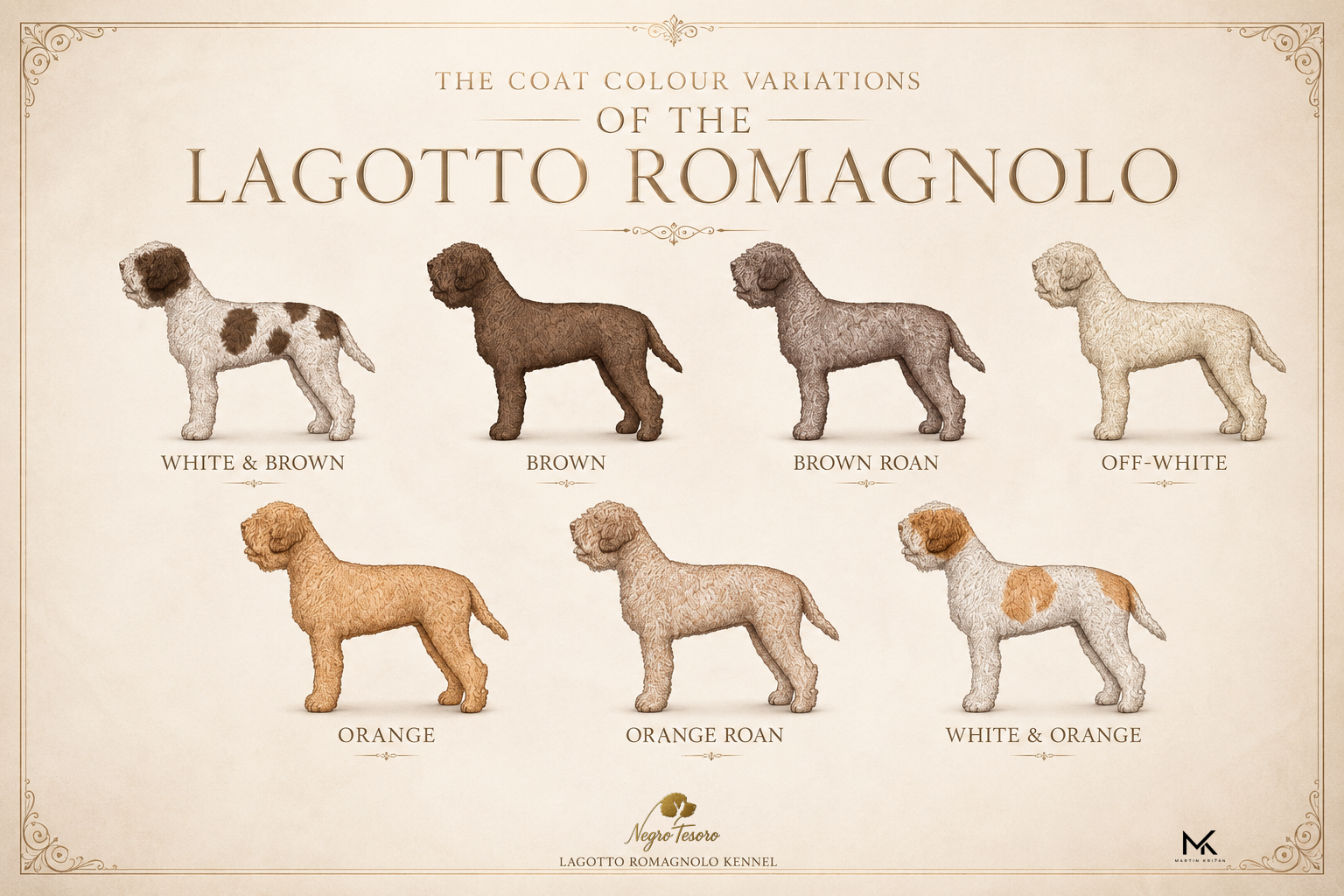
Lagotto Romagnolo Colours
Permitted colours are solid off-white; white with brown or orange patches; orange roan; brown roan; brown in various shades, with or without white; and orange, with or without white. A brown to dark-brown mask and tan markings in various shades are also allowed.
Colour alone does not determine quality. Overall type, sound construction, temperament and conformity to the breed standard are what matter.

An Intelligent Dog with a Natural Willingness to Work
The Lagotto Romagnolo has a natural aptitude for searching and an excellent nose. It is keen, attentive, affectionate and easy to train. Strongly attached to its owner, it is not only a working dog but also a very good companion and an excellent watchdog.
A correct representative of the breed should be neither aggressive nor overly shy. Temperament should be stable, tractable and consistent with the breed's working origins.
Truffle Specialist
Thanks to its excellent nose and natural aptitude for searching, the Lagotto Romagnolo is uniquely specialised in truffle searching.
Keen and Devoted
Attentive, willing to work with people, easy to train and strongly bonded to its owner.
Focused on the Task
The former hunting instinct has been modified through selection so that the scent of game does not distract the dog while working.
The Standard Safeguards Type, Health and Function
Any departure from the points described in the standard is considered a fault. Its seriousness is judged in proportion to the degree of the departure and its effect on the dog's health, welfare and ability to perform its traditional work.
The examples below are selected disqualifying faults. The full list and exact wording are given in FCI Standard No. 298.
Degree Matters
A fault is assessed according to how markedly the dog departs from the standard and whether this affects health, welfare or function.
Stability Is Essential
Aggressive or overly shy dogs, dogs clearly showing physical or behavioural abnormalities, and untypical specimens are disqualified.
Typical Head Proportions
Converging axes of the skull and muzzle, a dish-face, an overshot bite, a pronounced undershot bite or a wall-eye are disqualifying faults.
No Extremes
A tail curled over the back, absence of the tail or a short tail, whether congenital or artificial, a docked tail, and height outside the permitted range are disqualifying faults.
Curly, Natural Coat
A coat that is not curled, is clipped too short, is corded or has been given a sculptured clip is disqualifying.
Black Is Not Permitted
Partial or total depigmentation, black coat colour, black patches or black pigmentation are disqualifying faults.
The Breed Standard as a Foundation for Responsible Breeding
This page is intended as a clear, accessible guide to the Lagotto Romagnolo breed standard. It does not replace the official FCI document, but helps visitors understand the characteristics that define a typical representative of the breed.
FCI Standard No. 298
Official international breed standard for the Lagotto Romagnolo.
OPEN FCI STANDARDENCI Commentary on the Breed Standard
Extended commentary on the breed standard, with practical guidance on type and proportions.
OPEN ENCI COMMENTARY